Table of Contents
Table of Contents
Who was Honoré Daumier?
Honoré-Victorin Daumier (1808-1879) was a French printmaker, painter, and sculptor, but he was most famous in his own time as a relentless social and political satirist.
As a caricaturist and lithographer, he was one of the more compassionately devastating observers of Parisian life the nineteenth century managed to produce.
Over a career of remarkable, almost compulsive output – approximately 4,000 lithographs published in the French satirical press – Daumier drew lawyers performing, readers absorbed, travelers suffering in railway carriages, citizens conducting themselves with great seriousness.

The Michelangelo of Caricature
The most forward-thinking artists and writers of the 19th century saw Daumier not as a mere cartoonist, but as a master of form and a profound observer of the human condition. His genius was so apparent to his peers that the great novelist Honoré de Balzac reportedly declared, “there is some Michelangelo in that fellow.”
Meanwhile, the poet Charles Baudelaire went a step further, positioning Daumier not only as a master but as a pioneer, describing him as “one of the most important men, I will not say only of caricature, but also of modern art.”
Artist, journalist, and pioneer painter
Daumier was a master of lithography, a relatively new printmaking technique that allowed for faster, cheaper, and more expressive reproduction of images than ever before. It enabled him to draw directly onto a stone with a greasy crayon, capturing a fluid, sketch-like energy that was perfect for caricature. His lithographs were mostly developed for popular Parisian daily and weekly newspapers like La Caricature and Le Charivari. These publications were the internet and social media of their day, a way for the masses to get news and commentary that was visually immediate and often critical of those in power. And in that sense, Daumier was not only an artist, he was a journalist.
Sidebar: For a glimpse into Daumier’s 19th century Paris, watch Lost Illusions (2021). The award winning film, adapted from the novel by Honoré de Balzac, plunges you directly into the newsrooms and theaters of Paris. It vividly shows how “buzz” was manufactured, how critics could be bought, and how public opinion was a commodity for sale – all themes Daumier explored in his prints. The movie is a gorgeously stunning drama that makes you feel the speed, corruption, and intoxicating power of the media in Daumier’s time.
However, he was so famous as a caricaturist that the art establishment couldn’t take him seriously. As a painter, Daumier was largely a failure in his lifetime, forever typecast as a “funny man,” and not a real artist. The official Paris Salon (the jury-run exhibition that could make or break an artist’s career) often struggled with his paintings, perceiving his work as “ugly” and “unfinished.” At the time, Daumier’s focus on working-class people, lawyers, and grim, un-idealized scenes was considered coarse and unworthy of “High Art”; his expressive, sometimes rough brushwork was seen as lacking the polish demanded by the Academy.
While the Salon jury turned him away, Daumier’s contemporaries in the Barbizon School, like Jean-François Millet and Camille Corot, revered his commitment to realism and empathy for the common man. The next generation went even further; the Impressionists, especially Manet and Degas, saw him as a foundational figure. They were captivated by the very qualities the Academy rejected: his un-prettified subjects, his daring compositions, and his energetic lines. For them, Daumier’s work was a radical new blueprint.
Fearless political critic and champion of humanity
In the politically turbulent years of 19th-century France, Daumier took incredible risks. His most famous political print, Gargantua (1831), depicted King Louis-Philippe as a gluttonous giant, devouring the wealth of the nation while excreting honors for his cronies.
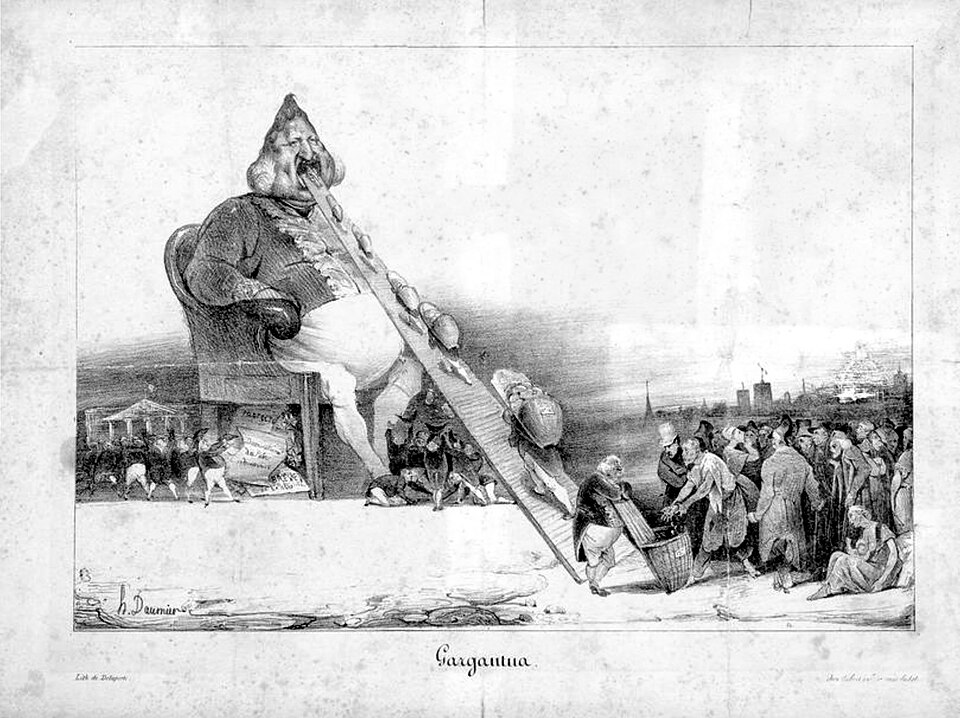
The satire was so biting that Daumier was imprisoned for six months, which sent a clear message: his art was powerful enough to be considered a threat to the state. This event cemented his reputation as a courageous champion of the people.
After 1835, strict censorship laws were enacted, forcing Daumier to abandon direct political attacks and pivot to the social satire he is now most famous for.
With political cartoons no longer an option, Daumier’s great subject became the Parisian bourgeoisie – the powerful and rising class of property owners, professionals, and merchants who were quickly replacing the old aristocracy. Daumier gently (and sometimes not-so-gently) poked fun at ostentatious social climbers, pompous lawyers and judges, pretentious art critics, and the familiar trials of daily life (garden pests, cranky landlords, nosy neighbors).
“Daumier met brutality with exposure, folly with laughter, pomposity with a twinkling prod. His astonishing lack of sentimentality made him accurate; his unfathomable humanity preserved him from savagery… Daumier could be amused, sorrowful, indignant, sharp: he was never vicious.”
– Roger Kimball, “Strange Seriousness”: Discovering Daumier
Daumier captured universal frustrations so well that his audience immediately recognized the world around them, and even themselves, in his work. Because his humor was so humane and relatable, even the bourgeoisie he satirized was part of his primary audience. Buying the paper and being “in on the joke” was like a sign of sophistication.
For the average Parisian, Daumier was a celebrity. His lithographs were a staple of city life. People would look for his latest print to get a laugh, a dose of social commentary, or a visual summary of the day’s events. He was the most famous visual satirist of his era. His genius was in finding the underlying humanity in these scenes. The expressions of frustration, vanity, confusion, and simple joy on his characters’ faces are as relatable today as they were in the 1850s.
Dramatic Delights de Daumier
The Dramatic Delights de Daumier greeting cards are a small collection of the work of this fascinating artist, brought into the 21st century with digital enhancement and captions to complement the humor and humanity so vividly captured in his original illustrations. The cards make for fun, sweet ways to connect with people you care about, and they’re also a little piece of art and history.
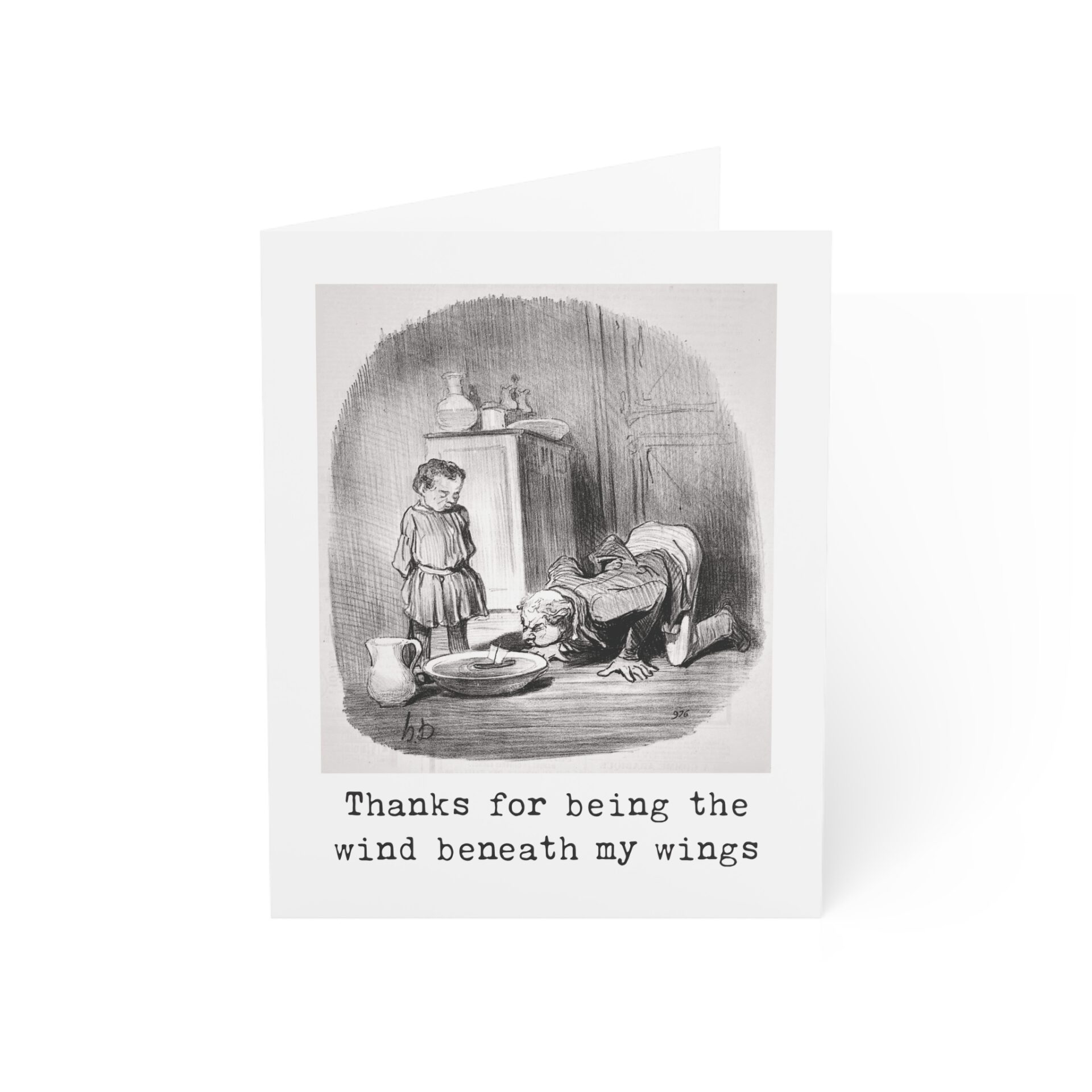
Wind Beneath My Wings
Daumier found humor in small, earnest moments of family life, like this adult attempting to teach a child how to play with their toy.
This is for the person who does the unglamorous, on-their-knees work of keeping things moving. A silly, sweet thank-you for parents, partners, friends, and anyone who shows up when it matters.
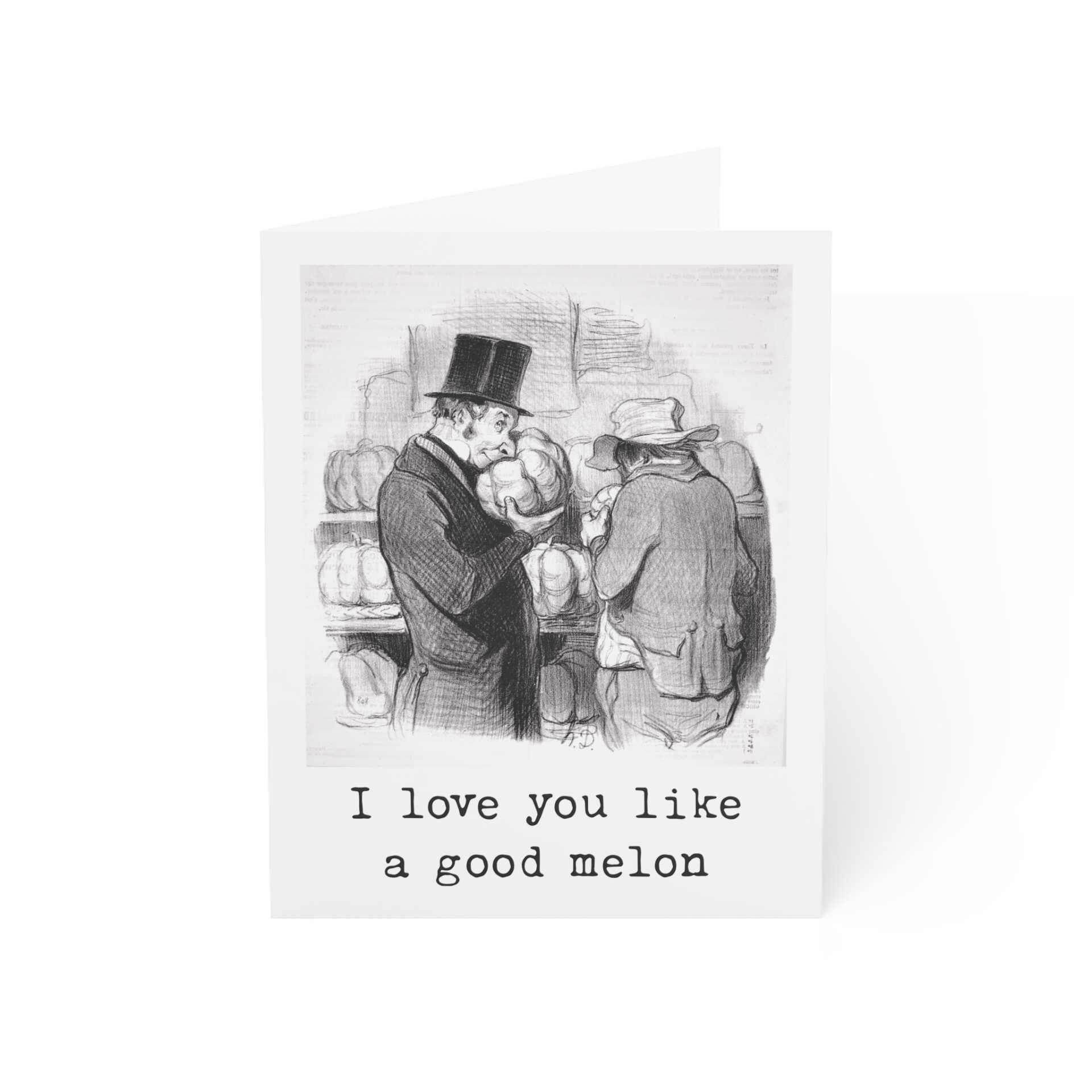
A Good Melon
Daumier captured his fellow Parisians in all kinds of daily activities, including shopping in the markets, where selecting the perfect produce was considered both a skill and a serious pleasure.
This card is for someone you’ve chosen carefully and hold tenderly. An affectionate card for people who just have that special flavor. Also works for anyone who takes grocery shopping seriously.
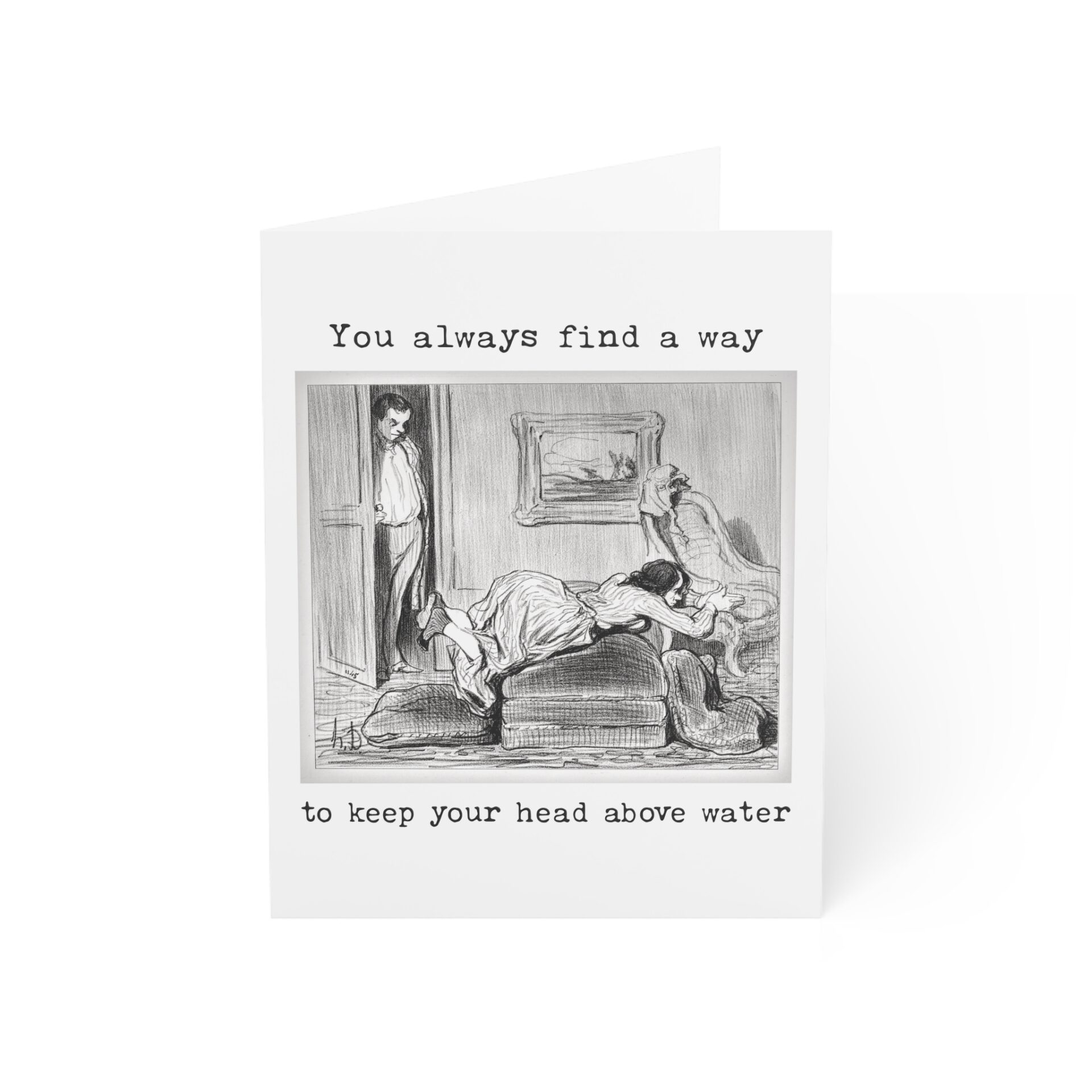
You Always Find a Way
Daumier’s series Les Baigneuses (“The Bathers/Swimmers”) poked gentle fun at city-dwellers awkwardly trying to master new physical skills, from gymnastics to swimming.
This is for the person who’s figuring it out as they go, and somehow making it work. They may or may not be in deep water, but they’re putting in the practice. A bit of encouragement for creative problem-solvers, career-changers, new parents, and anyone doing their best with what they’ve got. A reminder to just keep swimming.
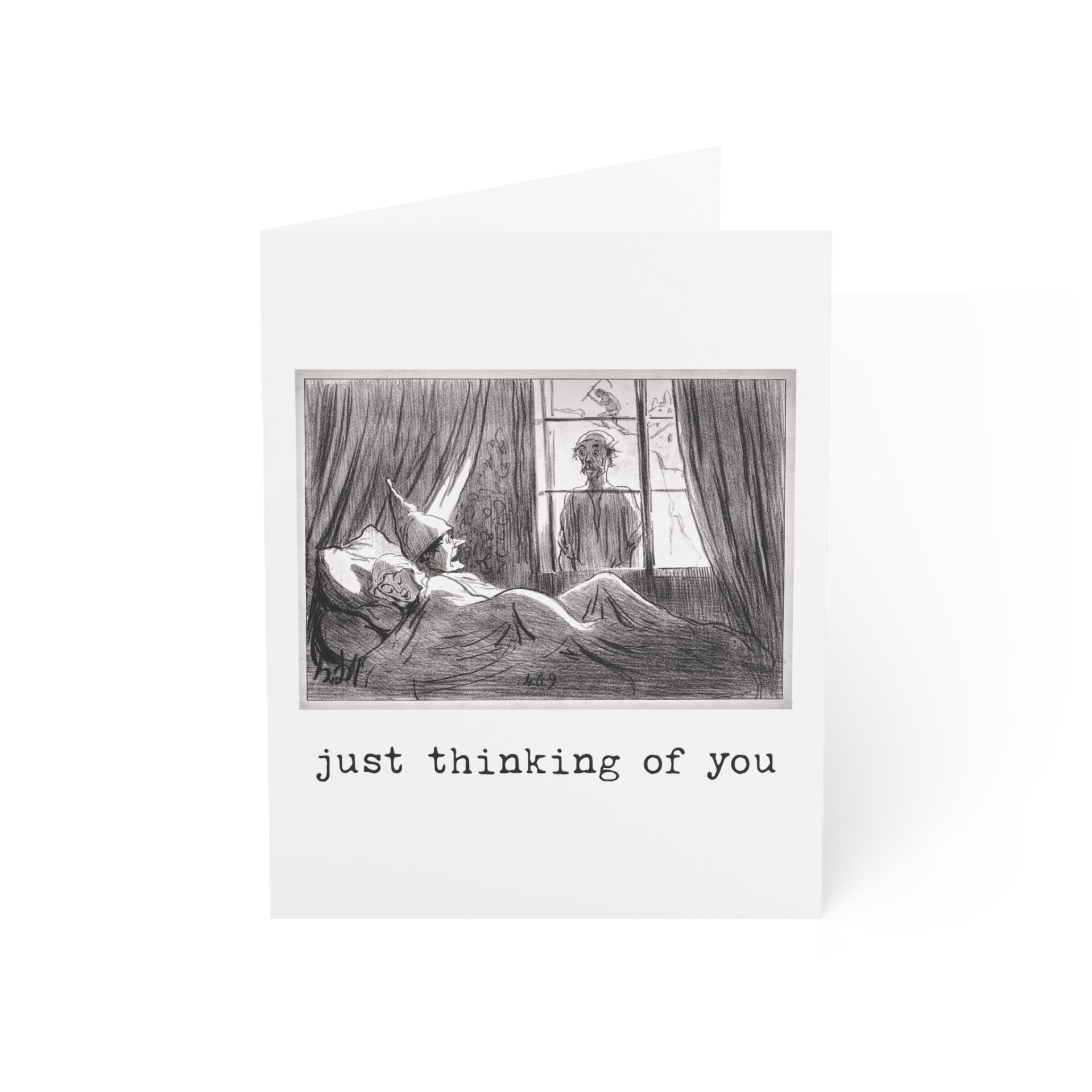
Just Thinking of You
Daumier was a master of capturing the daily dramas of life, some real, and some hypothetical – but the unwelcome surprise of an early morning visitor sounds like a bad dream either way.
Perfect for when you want to let someone know they’re on your mind, perhaps with slightly unhinged energy. Best sent to someone who’ll laugh. Not recommended for new relationships.
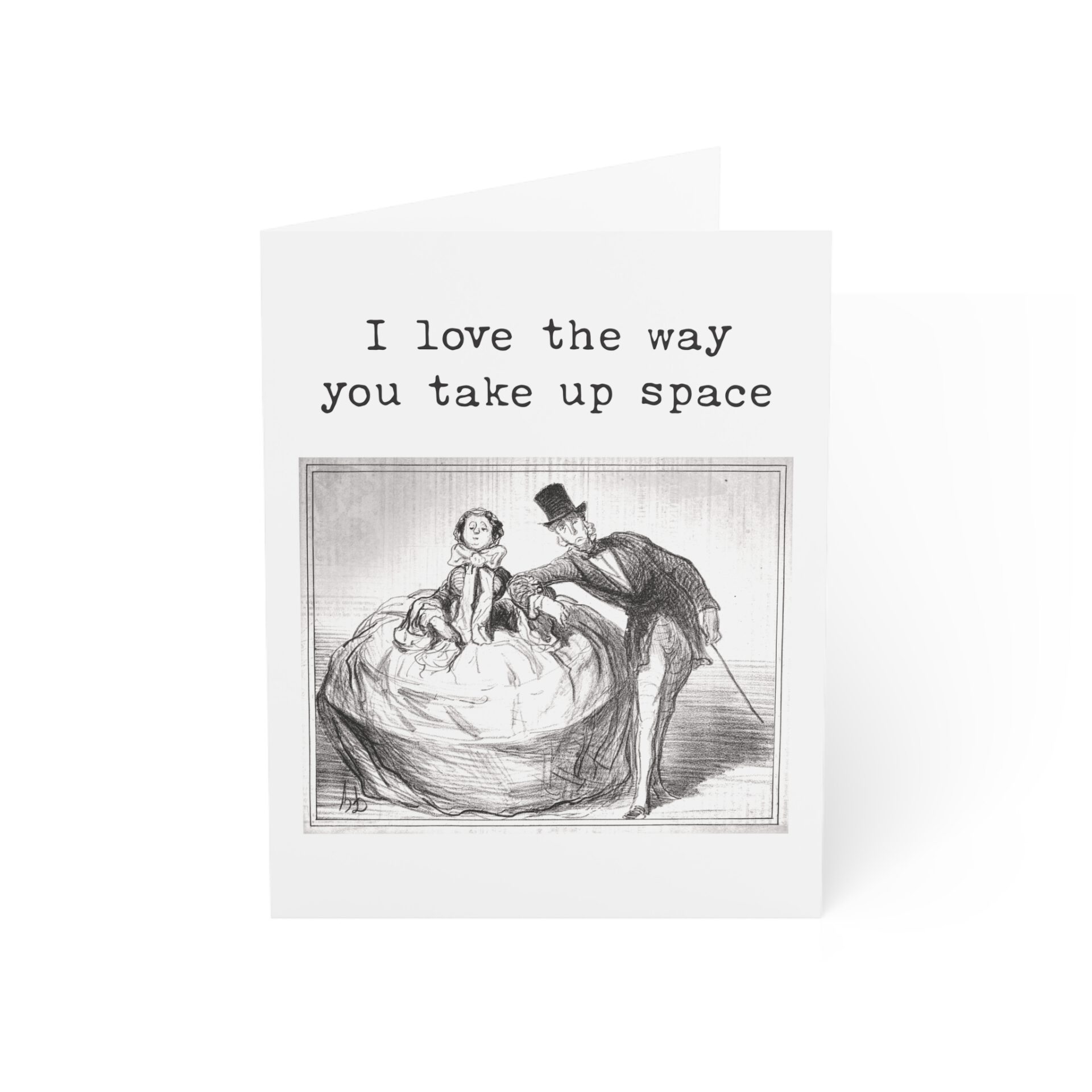
Take Up Space
In Daumier’s time, the enormous steel-caged crinoline skirt was a popular fashion trend that took up a spectacular amount of space.
This card is for the person who walks into a room and fills it (or maybe is learning to do so). A celebration of someone’s presence: big energy, big personality, no apologies. Works for friendship, love, or a very good pep talk.
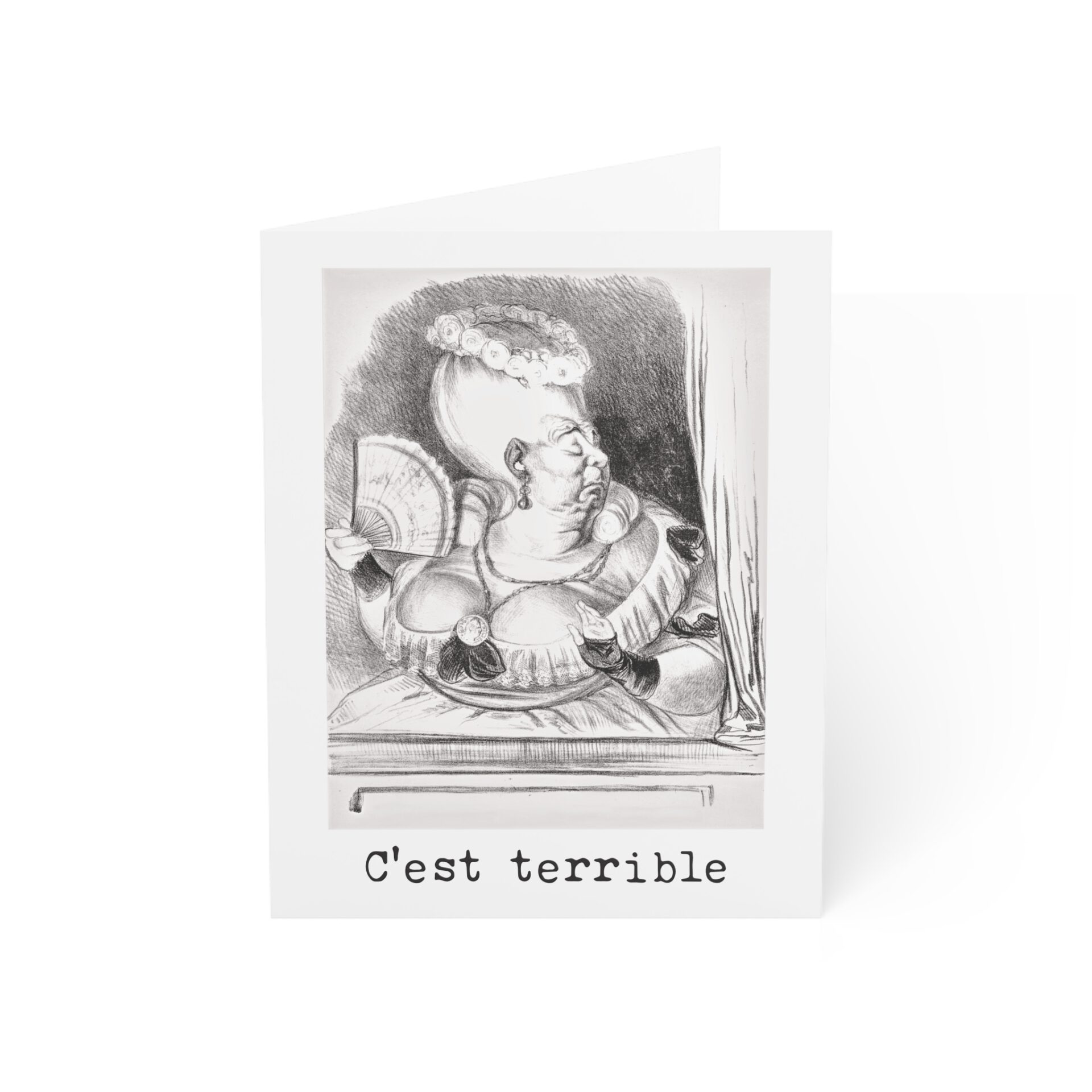
C’est Terrible
Daumier also satirized the theater, where the passionate, often exaggerated reactions of the bourgeois audience members in their private boxes were part of the spectacle.
For bad dates, bad news, bad policies, bad weather, and bad art. The most versatile card in the collection. She’s horrified so you don’t have to find the words. Pair with wine or send alone.
Be ready for anything, with humor and warmth
As in 19th century France, modern life is full of nuanced moments, sometimes dramatic, sometimes delightful. The complete Dramatic Delights de Daumier collection is an emotional toolkit to tuck away for the right time, with six distinct cards for everyday occasions: encouragement for a friend who’s figuring it out, goofy gratitude, heartfelt love (like a good melon), and dramatic commiseration when things are just terrible. Turn your desk drawer into a curated Parisian paper shop, always ready to connect with the people in your world.
For further exploration
Roger Kimball (New Criterion) – https://newcriterion.com/article/ldquostrange-seriousnessldquo-discovering-daumier/
Metropolitan Museum of Art – Daumier Drawings https://www.metmuseum.org/met-publications/daumier-drawings
National Gallery of Art (Washington) – Artist profile and collection
https://www.nga.gov/artists/1209-honore-daumier
Baudelaire, Charles – Quelques caricaturistes français (1857)
Childs, Elizabeth C. – Daumier and Exoticism: Satirizing the French and the Foreign (2004)
Laughton, Bruce – Honoré Daumier (1996)
Passeron, Roger – Daumier (1981)